I. The Essence: It Is All You
At the very core of my existence and my practice lies a single, immutable
truth: All is One. It is all you. This is not merely a poetic sentiment or a comforting
thought; it is the fundamental reality of consciousness itself, the bedrock upon which the ancient
science of Yoga is built. From the smallest atom to the grandest galaxy, from the individual soul to the
cosmic consciousness, there is no separation. The illusion of duality—of 'me' versus 'you', of
'internal' versus 'external'—is the veil of Maya that Yoga seeks to lift.
When I say "It is all you," I am speaking to the profound realization of Advaita Vedanta, the
non-dualistic philosophy that underpins the yogic tradition. You are not just a body, fragile and
transient. You are not just a mind, chaotic and constantly changing. You are the silent observer, the
eternal witness (Sakshi), the pure consciousness (Brahman) that illuminates all experience. The world
you see outside is a reflection of the world inside. The peace you seek in the mountains, the love you
seek in relationships, the stability you seek in wealth—all of it is already present within you, waiting
to be uncovered.
In our modern lives, we are conditioned to look outward. We identify with our titles, our possessions,
our successes, and our failures. We fragment ourselves into roles: the employee, the parent, the friend,
the stranger. This fragmentation is the root of all suffering. It creates a sense of isolation, a fear
of insufficiency, and a desperate race to 'become' something. But Yoga teaches us that we do not need to
become anything; we simply need to un-become everything that is not truly us. We need
to strip away the layers of conditioning, ego, and ignorance to reveal the radiant Self that has always
been there.
My philosophy is that every interactions, every challenge, and every breath is a mirror. When you step
onto the yoga mat, you are not just exercising your physical body; you are confronting yourself. The
resistance you feel in a forward bend is the resistance you hold in your mind. The shaking of your
muscles in a plank is the shaking of your resolving in life. The stillness you find in Savasana is the
stillness of your true nature. By practicing with awareness, we learn to recognize that the barriers we
perceive are self-imposed. We learn that the strength we need is already accessible. We learn that the
compassion we are capable of towards ourselves inevitably spills over into compassion for others,
because there is no 'other'.
"It is all you" means taking radical responsibility for your reality. It means understanding that you
are the creator of your perceptions. If you fill your inner world with judgment, the world appears
hostile. If you fill it with love, the world appears welcoming. Yoga provides the practical tools—Asana,
Pranayama, Meditation—to cleanse the lens of perception, to polish the mirror of the mind so that it
reflects the light of the Soul without distortion. This is the journey I invite you on: not a journey of
distance, but a journey of depth. A journey back to the Self.
THE SEAL OF EXCELLENCE
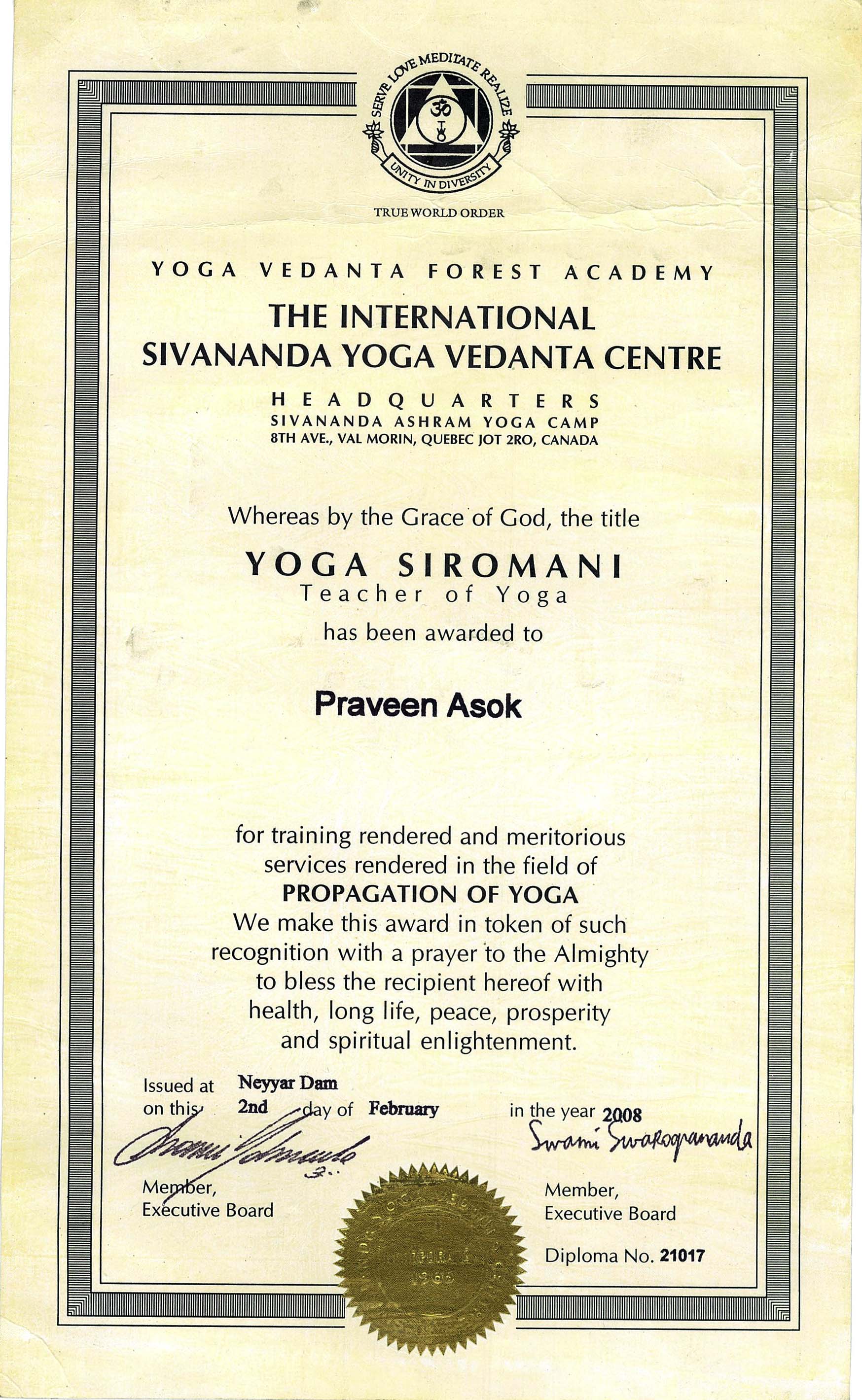
Official "Yoga Siromani" Diploma (No. 21017) awarded by the International Sivananda Yoga Vedanta Centre,
Neyyar Dam, India. Feb 2, 2008.
"We make this award in token of recognition with a prayer to the Almighty to bless the recipient hereof with
health, long life, peace, prosperity and spiritual enlightenment."
II. The Lineage of Light
No teachings in Yoga stand alone. Every true insight is a fruit borne from the tree of a Guru-Shishya
Parampara (Teacher-Student Lineage). My certification and my practice are deeply rooted in the Saraswati
lineage, specifically the tradition of Swami Sivananda of Rishikesh and his illustrious
disciple, Swami Vishnudevananda.
Swami Sivananda (1887–1963) was a medical doctor who, driven by a desire to cure human
suffering not just on the physical level but on the spiritual level, renounced his secular life to
become a monk. He settled in Rishikesh, the foothills of the Himalayas, and founded the Divine Life
Society. His teachings were characterized by their accessibility and synthesis. He did not advocate for
a secluded life of impossible austerity; instead, he proclaimed the "Yoga of Synthesis," combining the
four paths: Karma Yoga (Action), Bhakti Yoga (Devotion), Raja Yoga (Meditation), and Jnana Yoga
(Wisdom). His motto—"Serve, Love, Give, Purify, Meditate, Realize"—encapsulates the entire spiritual
path in six words. It is this spirit of selfless service and universal love that forms the ethical
foundation of my teaching.
Swami Vishnudevananda (1927–1993), known as the "Flying Swami" for his peace missions
piloting planes over conflict zones, was sent by Swami Sivananda to the West in 1957 with a simple
command: "Go and teach." He realized that the modern mind, skeptical and scientifically oriented, needed
a practical and systematic approach to Yoga. He distilled the vast, complex wisdom of ancient yoga into
five tangible principles (Proper Exercise, Breathing, Relaxation, Diet, and Thinking). He founded the
International Sivananda Yoga Vedanta Centres, creating a global network that has preserved the purity of
the teaching while making it relevant to contemporary life.
To hold the title of Yoga Siromani—which translates to "Jewel of the Crown of Yoga"—is
to bear the responsibility of this lineage. It is not merely a professional qualification; it is an
initiation into a family of spiritual seekers who have maintained the integrity of these practices for
thousands of years. When I teach, I am not teaching *my* yoga; I am transmitting the energy and the
wisdom of the Masters who came before me. This connection ensures that the practice remains potent,
safe, and spiritually grounded.
III. The Path of the Siromani
In February 2008, I undertook the transformational journey to the Sivananda Yoga Vedanta
Dhanwantari Ashram at Neyyar Dam, Kerala, India. Nestled in the lush tropical foothills of
the Sahyadri mountains, this ashram is a sanctuary of rigorous discipline and spiritual power. The
Teachers' Training Course (TTC) is widely regarded as one of the most intensive and authentic yoga
programs in the world.
For four weeks, life is stripped down to its essentials. The day begins at 5:30 AM with the sound of the
bell. We rise in the Brahma Muhurta (the ambrosial hours before dawn) for Satsang—silent meditation,
mantra chanting, and spiritual discourse. This sets the tone for a day of absolute immersion. There are
no distractions—no phones, no internet, no worldly news. Only practice.
The physical training is grueling and precise. Two two-hour Asana classes daily focus on mastering the
Hatha Yoga Pradipika's methodology. We didn't just learn how to *do* the postures; we learned the
biomechanics, the energetic effects, the modifications for injuries, and the art of correction. We
studied the 12 Basic Asanas in excruciating detail—from the inversion of Sirshasana (Headstand) to the
anterior stretch of Paschimothanasana. We learned to hold these poses not just with muscle, but with
Prana (breath energy).
Beyond the physical, the curriculum was an intellectual and spiritual odyssey. Under the tutelage of
senior Acharyas and Swamis, we dove into the ancient texts. We studied the *Bhagavad Gita*, analyzing
the battlefield of Kurukshetra as the battlefield of our own minds. We studied the *Yoga Sutras of
Patanjali*, dissecting the eight limbs of Raja Yoga and the psychology of the mind-stuff (Chitta). We
learned Sanskrit chanting, harmonizing our voices and vibrations with the cosmic sounds. We practiced
Kriyas (cleansing techniques) like Neti and Kapalabhati to purify the physical vessel.
A crucial component was Karma Yoga—the yoga of selfless service. Every student was
assigned duties, from cleaning the temple to serving food in the dining hall. This practice broke down
the ego. It taught us that no work is high or low; all work is worship when done with the right
attitude. Serving a meal became a meditation; sweeping the floor became an act of devotion.
The culmination of this training was the awarding of the diploma Yoga Siromani. This
title is not given lightly. It signifies that the recipient has not only mastered the techniques but has
demonstrated the character and the spiritual maturity required to guide others. It is a certification
recognized worldwide by the Yoga Alliance, but its true value lies in the inner transformation it marks.
I left Neyyar Dam not just with a certificate, but with a new vision of the world and my place in it.
IV. The Science of Evolution
My approach to teaching is grounded in the five principles established by Swami Vishnudevananda, which
validly bridge ancient wisdom with modern science. These are not religious dogmas but practical laws of
nature.
1. Proper Exercise
(Asanas)
Our physical bodies are meant to move. Asanas serve as a lubrication mechanisms for the joints, muscles,
ligaments, and tendons. Unlike mere calisthenics or weight training which build muscle often at the
expense of flexibility, Yoga focuses on the health of the spine. A flexible spine houses a healthy
nervous system. By systematically stretching and toning the body, we release physical tension and
mobilize energy blocks, keeping the body youthful and agile.
2. Proper Breathing
(Pranayama)
Breath is life. Most modern humans use only a fraction of their lung capacity, leading to low energy and
high stress. Pranayama teaches us to use the full capacity of our lungs, increasing oxygen intake and
revitalizing the entire system. On a subtler level, breath is the control mechanism for the mind. By
regulating the breath, we regulate our emotions and thoughts. "When the breath wanders the mind also is
unsteady. But when the breath is calmed the mind too will be still."
3. Proper Relaxation
(Savasana)
In a world of chronic over-stimulation, relaxation is nature's way of recharging. True relaxation is not
just sleep; it is a conscious state where the body, mind, and intellect withdraw from external stimuli.
In Savasana, we use autosuggestion to relax each muscle group, conserve energy, and allow the body's
natural healing intelligence to function unimpeded.
4. Proper Diet
(Vegetarian)
We are what we eat. A yogic diet is Sattvic (pure)—simple, natural, and easily digestible. It consists
of foods that give energy and lightness to the body and peace to the mind. By avoiding meats, processed
foods, and excessive stimulants, we cultivate a body that is a clean temple for the spirit and practice
non-violence (Ahimsa) towards other sentient beings.
5. Positive Thinking &
Meditation (Vedanta & Dhyana)
Ultimately, we become what we think. The mind is a powerful tool, but often a terrible master. Through
the philosophy of Vedanta, we learn to analyze the nature of the mind and remove negative thought
patterns. Through Meditation, we learn to focus the mind and transcend it, experiencing the deep silence
and peace of the Self.
V. The Mission
And so, we return to where we began: It is all you.
My mission as a teacher is not to make you flexible; it is to make you free. Flexibility of the
hamstrings is merely a side effect; flexibility of the mind is the goal. I am here to guide you through
the discomfort, to help you find your breath when things get difficult, and to remind you of your own
innate strength.
I invite you to step onto the mat with me—not to perform, but to practice. To explore the landscape of
your own body and mind. To serve your own well-being so that you may better serve the world. To love
yourself so that you may better love others. To realize that the peace you have been searching for in
the future, in the next job, in the next relationship, is already here, pulsing in the very beat of your
heart.
Thank you for allowing me to be a part of your journey.
Om Shanti, Shanti, Shanti.
